

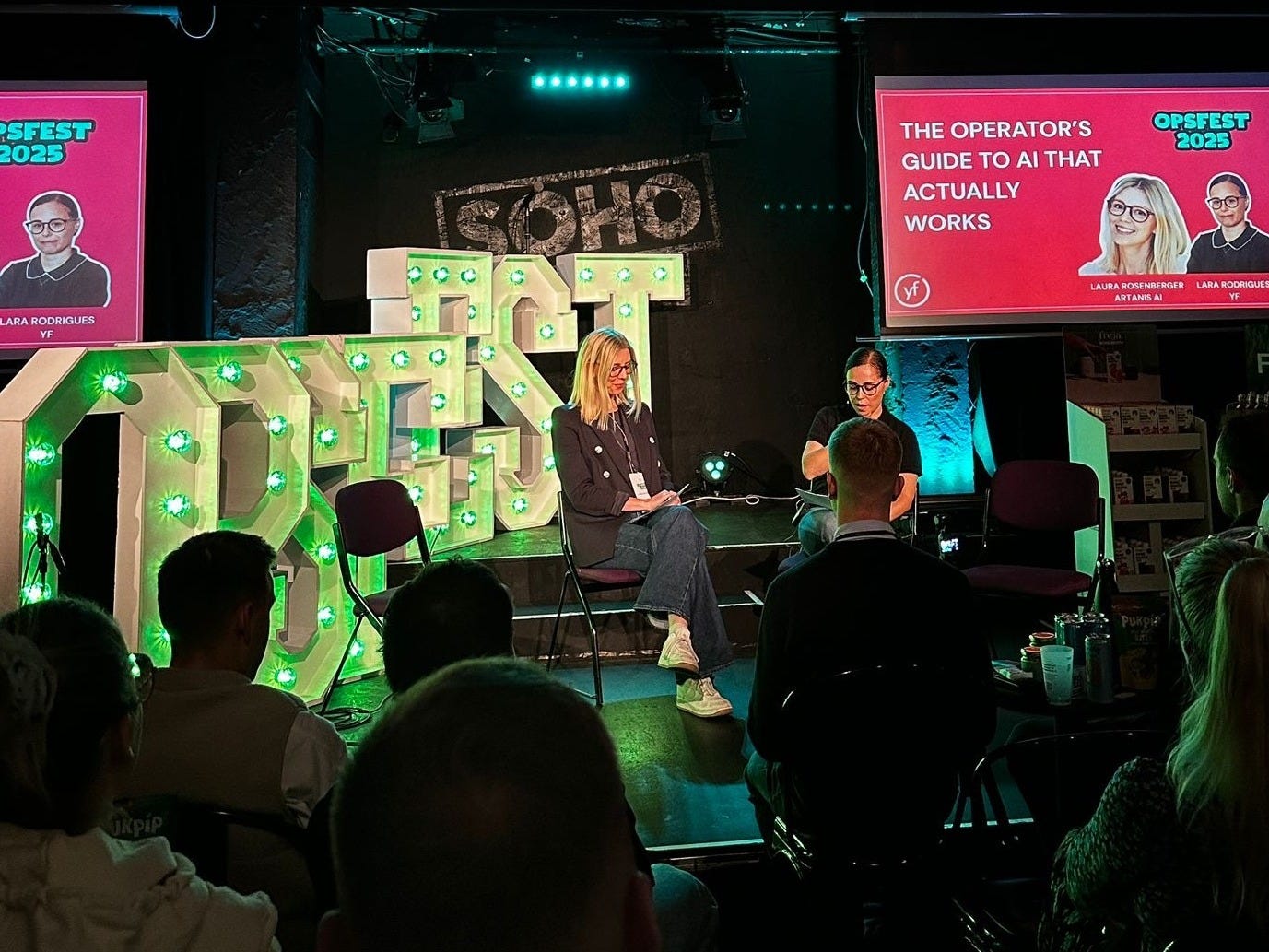
I spoke at a conference last week, doing a fireside chat about AI at an otherwise non-technical gathering for people at consumer brands.
I started with a temperature check - what has ever used any form of AI?
Everyone’s hand goes up.
Who uses it daily, across multiple tasks?
Almost everyone’s hand stays up.
Who works in a business which has started to operationalise it, by using it in processes and workflow?
The majority of hands come down.
Whose business looks fundamentally different to two years ago thanks to AI?
One solitary hand remains up.
This is pretty representative of the businesses I speak with. Very few have made the jump from individuals using it in their day-to-day work, to operationalising it in their processes and workflows.
That gap - between everyone using AI and almost no one operationalising it - is the defining challenge of the moment. And it’s not because the tech isn’t good enough.
Why AI is hard
So we’re in a world where everyone is using AI in their day to day work, but not yet using it for anything bigger than that - it’s not part of their wider workflows, and it is not used to do processes autonomously that were previously done manually.
Why is it so difficult to make the leap from the personal to the organisational?
I see these difficulties separate into three buckets: process, performance and people
Problem 1: Process issues
When I started working with a team of AI engineers, I was surprised to learn that one of the most common reason AI projects fail is that teams haven’t properly broken down their own processes.
They aren’t able to say exactly how their work actually happens. They can’t precisely describe what the steps and decisions are, what good looks like, which parts of a process are judgment calls vs. rule-based (crucial for AI vs just straight up automation), or where the data that informs those judgements lives.
Without that, how could we design an AI system that reliably replicates it?
A great example is this one. Trying to get an AI image model to generate architectural floor plans is extremely hard. But when you break the problem into smaller steps as an architect does (which rooms go next to which, for instance) the problem becomes easier for AI to solve.

Problem 2: Performance Issues
If you’re investing the time and money to build AI systems, they need to actually work. The stakes are high and so is the bar for what “good enough” means.
A common cause of failure is getting access to good data. Sometimes it’s the access that is the problem (it’s locked in legacy systems) but more often, the real issue is that the data itself isn’t fit for purpose. How do people actually record information, not just how they’re supposed to? What inconsistencies that have crept in over time and what nuance is trapped in people’s head instead of being contained in the data?
Then the next question is: how do you know if your AI’s outputs are good enough?
Yes, your tech team should run evaluations (evals). But someone needs to define what those evals should measure in the first place. Who determines what “good” actually looks like? What level of error tolerance would you have for a human doing that task?
Finally, there are some situations where an AI is never going to perform to the level where you can get ROI. Sometimes there’s simply not enough volume or repeatability to justify the investment. Sometimes the process is too complex or high-stakes to trust letting go of the reigns to an AI system (at least not yet!)
Problem 3: People Issues
Ah yes, then there’s the most unpredictable part of all. Humans!
Everyone’s had ChatGPT confidently give them complete nonsense. Now you’re asking them to trust a similar system with work that could cause serious damage if it goes wrong.
If you build it, will anyone actually use it or will they quietly keep doing things the old way because it feels safer? AI feels scary to a lot of people (understandably) and you can’t assume adoption is automatic.
Someone has to own AI - champion it across the organisation, help people work through resistance and take responsibility when rollout gets messy.
All of this needs to be handled thoughtfully and carefully, by someone who understands both the technology and how organisations work.
What skills would stop AI projects failing?
All of these things together make the thought of trying to operationalise AI feel insurmountable.
But if you feel in your bones (as do I) that AI isn’t going anywhere and being at the forefront is going to pay dividends, then how do you go about starting to take action?
Let’s pick apart the skills and qualities needed to overcome these challenges above:
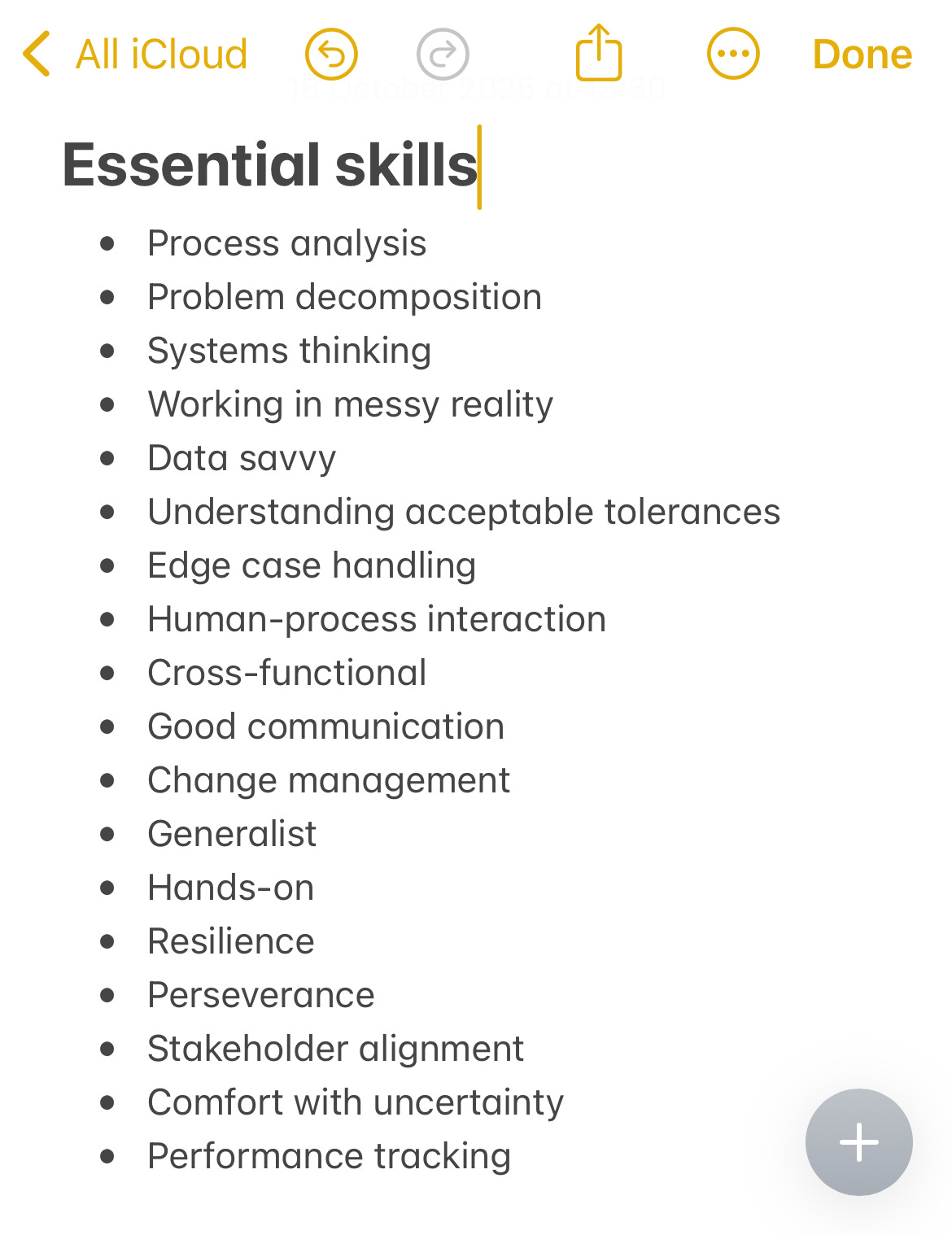
Sound like anyone you know?
There are people who already do this
Yep, operations people.
Not just supply chain and logistics (some people seem to hear ‘ops’ and think of truck and warehouses!). I mean anyone whose job is making the processes which power the business to actually work.
The person who redesigned your customer service workflow when response times went to through the roof. The one who spotted that your “sales problem” was actually a fulfilment problem. The guy who spent two weeks shadowing your warehouse team to figure out why the new system wasn’t being used properly.
These are the people who already do the hard work AI implementation needs: understanding messy processes, defining what “good enough” actually means in practice, and getting humans to change how they work. They just haven’t been doing it with AI yet.
“But I’m not technical!”
Good!
I’ve come to realise that being non-technical is an advantage. The world is crying out for AI that works. AI engineers can make the technical side work, but operators are need to make the business side work.
The imposter syndrome is real, I felt it too. But the only way we’re going to get out of a world where 95% of AI projects fail is if operators get involved in them.
If you’ve been thinking “I should probably figure out this AI thing”, you don’t need to google prompt engineering or learn Python.
You need to do what you’ve always done, but this time, with the most revolutionary tool we’ve ever seen in our career.
I'd have the operator count the work created by wrong outputs in another team's queue as part of the evaluation. A customer-service draft could be quicker to produce and still cost more to use if someone else has to check the promise it makes.
great work please keep the posts coming